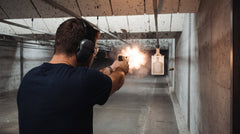


The Bill Drill is six shots from the holster into the A-zone of a USPSA target at 7 yards, timed from the beep to the last shot. Most published standards put a clean run under 3.5 seconds as a solid goal and 2 seconds or less as expert level. Enter your run below to see your hit factor, how much of your time is the draw, and which benchmark you meet.
Bill Drill calculator: loading. If it does not appear, refresh the page.
How it works: points use the official USPSA zone values (A 5, C 3 or 4, D 1 or 2, miss −10) and hit factor is points divided by time, as in USPSA rule 9.2.2.1. The benchmark table lists published times from Outdoor Life, Shooting Illustrated, Safariland, GAT Daily and Wilson Combat, each named in the par time table. There is no official Bill Drill classification, so treat the levels as reference points, not grades. For runs with hits outside the A-zone, the calculator also shows Safariland's adjusted time (one second added per hit outside the A-zone). Your numbers stay in your browser.
What Is the Bill Drill?
The Bill Drill is a handgun standard: draw and fire six rounds into the A-zone of one target at 7 yards as fast as you can while keeping every hit in that zone. It tests the draw, recoil control and trigger speed in one short string. Pistol-training.com sums up the purpose: “The Bill Drill is intended to improve speed without sacrificing accuracy.”
It is named after Bill Wilson, founder of Wilson Combat and an early IPSC and IDPA competitor. GAT Daily writes that Rob Leatham “dubbed this exercise the Bill Drill after Bill Wilson of Wilson Combat” during the late 1970s and early 1980s. Safariland, Outdoor Life, SSUSA and pistol-training.com also credit Wilson. Not everyone agrees: a 2017 Shooting Illustrated article says “which Bill is not clear” and lists Bill Jordan and Bill Rogers as candidates. Wilson Combat's own channel calls those versions a mistake: “Some people mistakenly say the Bill Drill got its name from Bill Rogers, Bill Jordan… but we know the real origin.” In November 2026 Wilson Combat published a video with Bill Wilson and Rob Leatham on the origin. We could only read its description, so we do not quote a year or place.
What the drill teaches, in Shooting Illustrated's words: “First is a fast draw. It also trains for a fast trigger finger for rapid follow-up shots. It teaches recoil control and—most importantly—the kind of sight-picture discipline that allows you to put rounds on the target.”
How to Set Up and Shoot the Bill Drill
You need one USPSA (IPSC) cardboard target, a shot timer, a holster you can draw from at speed, six rounds and a range that allows drawing from the holster and rapid fire. Many indoor ranges do not; ask first.
- Set the target at 7 yards (6.4 m, 21 ft). Ben Stoeger calls 7 yards “the ‘standard’ distance for a bill drill.”
- Load six rounds or more, holster the pistol and face the target.
- Pick a start position and keep it: hands relaxed at your sides, or the surrender position with hands at shoulder height or above. Sources differ, so note which one you use, or your times are not comparable.
- At the beep, draw and fire six rounds into the A-zone as fast as you can keep them there.
- Read the time of the sixth shot from the timer, and the time of the first shot if your timer shows it.
- Score the target. All six in the A-zone is a clean run. Write down time, hits and start position.

| Element | Standard version | Where sources differ |
|---|---|---|
| Distance | 7 yards (6.4 m) | Stoeger also runs it at 3 and 5 yards |
| Rounds | 6 | None |
| Start | Pistol holstered | Hands at sides (Outdoor Life) or surrender (pistol-training.com, SSUSA); Shooting Illustrated allows either |
| Target zone | USPSA/IPSC A-zone, 15 × 28 cm (5.91 × 11.02 in) | IDPA “Down 0” zone (8 in circle) accepted by GAT Daily and SSUSA |
| Hits outside A | Run is not clean | Shooting Illustrated and SSUSA: failure. Safariland: +1 s per hit. Stoeger: “the occasional close ‘C’ is no big deal” at longer ranges |
| Time | Beep to sixth shot, one string | None |

What Is a Good Bill Drill Time?
There is no single answer, and anyone who gives you one without a source is guessing. The Bill Drill is not a USPSA classifier, so no official table of classes exists. These are the published benchmarks we could verify, all for clean runs at 7 yards from the holster:
| Time (clean) | What the source calls it | Source |
|---|---|---|
| Under 5.0 s | “doing pretty well” | Outdoor Life (Tyler Freel, 2023) |
| About 4.0 s | “for those who are new to working from a holster” | GAT Daily (P.E. Fitch, 2022) |
| 4.0 s | “Most good shooters can do it in 4 seconds” | Shooting Illustrated (Bryce Towsley, 2017) |
| 3.5 s | “a solid goal to aim for”; “a reasonable … par time for most shooters” | Safariland (Travis Pike, 2024); GAT Daily |
| 3.0 s | Drill of the Week standard: “in 3 seconds or less” | Wilson Combat (YouTube, March 2026) |
| 3.0 s | “a reasonable goal for mere mortals” | Shooting Illustrated |
| Under 3.0 s | “Master Class shooting” | SSUSA (Chris Christian, 2018) |
| 2.0 s or less | “an expert time” | Safariland |
| 2.0 s | “the most commonly stated goal”, which “would make you a master-class shooter” | Shooting Illustrated |
| 2.0 s | “a very reasonable goal for this distance” | Ben Stoeger (USPSA Grandmaster) |
| 2.0 s | Bill Wilson's original par | Rob Leatham (Personal Defense Network, 2018); GAT Daily citing Brian Enos |
Read the table critically. The same 2 seconds is “very reasonable” to a Grandmaster, “expert” to Safariland and “master-class” to Shooting Illustrated. Labels depend on who is talking. The numbers themselves cluster clearly, though: about 4 seconds is where a trained beginner lands, 3 to 3.5 seconds is a solid shooter, and 2 seconds is a skilled competitor.
Real-world perspective from shooters: on r/CCW, a self-described defensive pistol trainer in North Carolina wrote that “Less than 1% of people who regularly compete, train, practice, and dry fire can pull a sub 2 second Bill Drill from concealment with any degree of regularity.” Another commenter in the same thread suggested that “to be a competent shooter, you should be aiming for sub 3 seconds clean.” Those are opinions, not data, but they match the published numbers.
Two more things decide whether your time compares with anyone else's: cold or warm (Stoeger's benchmark is the “first six rounds out of your gun for the day”), and holster. A run from an open competition rig and a run from under a shirt are different tests.
Where the Time Goes: Draw vs Splits
Every Bill Drill time is two parts: the draw (beep to first shot) and five splits (time between shots). Stoeger breaks his 2 second goal into “a one second draw and .2 second splits.” The table shows what other combinations give. It is plain arithmetic: total = draw + 5 × split.
| Draw (first shot) | Splits 0.20 s | Splits 0.25 s | Splits 0.30 s | Splits 0.40 s |
|---|---|---|---|---|
| 1.0 s | 2.00 s | 2.25 s | 2.50 s | 3.00 s |
| 1.3 s | 2.30 s | 2.55 s | 2.80 s | 3.30 s |
| 1.5 s | 2.50 s | 2.75 s | 3.00 s | 3.50 s |
| 2.0 s | 3.00 s | 3.25 s | 3.50 s | 4.00 s |
Two lessons from that table. First, a 2 second Bill Drill is out of reach without a draw near 1 second, however fast your trigger is. Second, most shooters lose more time to the draw than to the splits. One r/CCW commenter put it plainly: “Your draw to first shot is going to present the biggest time savings by far.” That is also the cheapest part to train, because the draw can be practised in dry fire at home.

How to Score the Bill Drill
There are three ways to score it, and the calculator shows all three.
1. Clean or not (the classic way)
All six hits in the A-zone, or the run does not count. Shooting Illustrated: “You must have all six in the ‘A’ zone to shoot the Bill Drill clean.” This is the version behind the benchmark times above.
2. Time penalty
Safariland's version keeps every run but adds time: “Every shot outside the A or -0 zone adds one second to your time.” A 2.6 second run with one C hit becomes 3.6 seconds. It is a harsh but honest way to stop yourself trading accuracy for speed.
3. Hit factor (USPSA style)
Competition shooters often score it like a USPSA stage: points divided by time. The USPSA rules (edition 2026-09) give these values:
| Hit | Minor power factor (most 9mm) | Major power factor |
|---|---|---|
| A-zone | 5 | 5 |
| C-zone (B is scored as C) | 3 | 4 |
| D-zone | 1 | 2 |
| Miss | −10 | −10 |
A clean run is 30 points. At 2.00 seconds that is a hit factor of 15.00; at 3.00 seconds it is 10.00. On r/USPSA one shooter's “17 HF” was translated straight back by another as “a clean bill in 1.75 seconds”, which is exactly 30 ÷ 1.75. Hit factor has one catch: five A's and one C in 2.50 seconds (28 ÷ 2.5 = 11.20) beats a clean 3.00 second run (10.00). That is how USPSA rewards speed, but it is not a clean Bill Drill. Use hit factor to compare your own runs, and the clean standard to judge them.
How to Get Faster at the Bill Drill
We are an equipment shop, not shooting coaches, so this section only repeats advice from named instructors and experienced shooters, with the source for each point.
- Learn doubles first. Stoeger: “I would recommend working on ‘Doubles’ before you progress to this drill.” Two fast, accurate shots are the building block of six.
- Practise the draw in dry fire. Safariland: “Drawstroke practice can be done dry without the need to expend ammo or go to the range.” Pistol-training.com's daily dry-fire routine starts “After triple checking that your firearm is empty and no ammo is in the room with you”, and its goal is “to draw to a sight picture and a fully prepped trigger.”
- Use a par time. A shot timer can beep a second time at a set moment after the start beep. Shooting Illustrated's Richard Mann explains that this lets you try to finish a draw or reload within that limit. An r/CompetitionShooting commenter's version: “Set a very aggressive par time and draw to a sight picture over and over, every day”, and the same thread suggests a sight picture in 0.6 seconds as a goal for a typical setup.
- Track the sights, do not wait for them. Pistol-training.com: shoot “as soon as the front sight comes back down onto the scoring zone”. An r/CompetitionShooting commenter saw the opposite mistake in a shooter's video: “a tendency to want to over confirm the first shot before ripping all 6.”
- Bring the gun to your eyes, not your head to the gun. Another comment from the same thread: “At presentation, you drop your head to the gun versus bring the gun up to your eye.”
- Relax. Pauses between shots often come from “too much firing hand tension”, and an r/CCW commenter adds that “tension adds to time too”. Film yourself to spot extra head or shoulder movement.
- Push, then refine. One r/CCW shooter who runs it around 1.8 s from an OWB holster described the cycle: “push speed until you’re throwing one or two Charlie’s. Slow it down and refine. Rinse and repeat.”
- Do not obsess over it. When a shooter at 1.69 seconds asked how to get faster, the most upvoted reply was “who gives af about shaving .15 off that?”, pointing to transitions, footwork, reloads and other skills instead. The Bill Drill is one test, not the whole skill set.
Use the calculator after each session: if the black draw bar is more than about half your time, train the draw; if your average split is above about 0.35 seconds, work on trigger and recoil control. Those two thresholds are our rule of thumb from the arithmetic table above, not a published standard.
Bill Drill Variations
| Variation | What changes | Source |
|---|---|---|
| From concealment | Draw from a concealed carry holster under a garment | Safariland; Outdoor Life (appendix carry) |
| Closer: 3 or 5 yards | Goal times 1.7 s and 1.8 s | Ben Stoeger |
| Longer: 10, 15 or 25 yards | Turns into a trigger control test | SSUSA; Stoeger |
| From low ready | No draw; for new shooters or to isolate the shooting | Safariland; SSUSA |
| Smaller target | Head box instead of the body A-zone | Shooting Illustrated |
| With reloads | Fire six, reload, fire six more | Shooting Illustrated |
| Bill Drill 2 | Five strings of 1 to 5 shots on an IDPA target, 10 s total goal | Bill Wilson, via pistol-training.com |
| Rifle or carbine | Much easier: no draw, more stable platform | Safariland |
From concealment, add time. An r/CCW shooter who runs 1.8 seconds from an OWB holster reported “Right around 2 from concealment”, and another posted “1.44 draw, 2.50 Bill Drill” from concealment. If you carry concealed, test from your carry holster and your normal clothes: that is the time that matters for you.

Bill Drill vs Other Pistol Drills
The Bill Drill tests raw speed on one easy target. It says nothing about reloads, precision at small targets or shooting one-handed. These standards fill the gaps:
| Drill | Setup | Standard | What it adds |
|---|---|---|---|
| Bill Drill | 7 yd, 6 shots, one USPSA A-zone | Under 3.5 s solid, 2 s expert (see above) | Draw and split speed |
| F.A.S.T. (Todd Green) | 7 yd: 2 shots at a 3×5 in card, slide-lock reload, 4 shots at an 8 in circle | “A sub 5 second clean run, twice in a row” for the F.A.S.T. coin | Precision and a reload |
| El Presidente (Jeff Cooper) | 10 yd, 3 targets, turn and draw, 2 shots each, reload, 2 each again | “under ten seconds with all A-zone hits” | Turn, transitions, reload |
| 5×5 Skill Test (Bill Wilson) | 10 yd, IDPA target, 4 strings of 5 shots incl. strong hand only and a reload | Grand Master 15 s, Expert 25 s, Novice 50 s | One-handed shooting, a head shot |
| Dot Torture (David Blinder) | 3 yd, 10 dots, 50 rounds | “You have to get all 50 hits to pass” | Pure accuracy, untimed |
Is the Bill Drill Useful for Self-Defense?
Yes as a skill test, with limits. It measures whether you can get the gun out and deliver accurate hits fast, which matters in any defensive situation. It does not measure judgment, and some shooters worry about the habit it builds. On r/CCW one commenter wrote that “the Bill drill has potential to leave training scars”, because shooting six rounds automatically is not the same as shooting until a threat stops. Another argued that de-escalation and mindset matter more than splits. Our view: use the Bill Drill to measure mechanical skill, and get decision-making training (from a qualified instructor, with scenarios and no-shoot targets) somewhere else. One drill cannot do both jobs.
Gear That Changes Your Bill Drill Time
Equipment does not replace practice, but it decides what kind of time is possible. Here is what we sell that is relevant, with the trade-offs stated plainly.
The holster
The fastest Bill Drills come from open-top competition holsters with no retention device to release. Everything we sell has some retention, which is a deliberate trade: the gun stays in the holster when you run, fall or wrestle. Safariland's ALS (Automatic Locking System) holsters lock the gun automatically when holstered and release it with a thumb swipe as you take your grip. That thumb movement has to become part of your draw, and it is worth dry-fire practice of its own. For a range and everyday OWB setup:
-

Solis® ALS® Concealment OWB Holster
Best seller$48.10 -

7378 7TS™ ALS® Concealment Paddle and Belt Loop Combo Holster
Best seller$61.30 -

6378RDS ALS® Concealment Paddle Holster
Best seller$102.60


The Solis is open-top and works with most compact red dot sights, the 7378 is a paddle and belt loop combo, and the 6378RDS is made for pistols with red dots. If you shoot the drill in duty gear, test with your duty holster: a Level I like the 6390RDS behaves very differently from a Level III. Our guides to holster retention levels, the best OWB holster, the best duty holster and the paddle holster explain the differences.

For concealment, see our appendix carry guide; if you shoot a Glock 19, there is a separate Glock 19 holster guide. Whatever you carry, the holster has to sit on a stiff belt, or the draw gets slower and less consistent; our duty belt setup, battle belt setup and best battle belt guides cover that.
Hearing and eye protection
Not optional, and not only because of range rules. NIOSH measured peak levels of 155 to 168 dB from law-enforcement firearms including 9mm, .40 and .45 pistols, while recommending no exposure above 140 dB. Its advice is to “Use double hearing protection (earplugs and earmuffs) whenever possible.” Six rapid shots per run, many runs per session, add up quickly; our gunshot decibels calculator shows how many shots a day each kind of protection allows. The Pro Impulse earplugs are reusable with an NRR of 33 dB; the Impulse Range Kit adds earmuffs and protective eyewear. More detail in our ear protection for shooting guide.
-

Pro Impulse® Hearing Protection
Best seller$32.00Current list price$41.60 -

Impulse® Range Kit
Price on request


Shot timer and range bag
You cannot shoot a Bill Drill without a timer. We do not sell shot timers; any dedicated timer or a timer app works, as long as it detects your shots reliably at an indoor or outdoor range. To carry the timer, ear and eye protection, magazines, pasters and ammo, a range bag keeps it in one place. Our best range bag comparison covers the options.


Safety Before Speed
The Bill Drill is about speed, and speed is when safety habits break. The basics apply on every run. The NRA's rules: “ALWAYS Keep The Gun Pointed In A Safe Direction”, “ALWAYS Keep Your Finger Off The Trigger Until Ready To Shoot” and “ALWAYS Keep The Gun Unloaded Until Ready To Use.” USPSA requires eye protection and “adequate hearing protection” for everyone on the range (rule 5.4.1). In practice for this drill:
- Only draw from a holster at speed on a range that allows it, and only after you can do it slowly and correctly.
- Keep the trigger finger straight along the frame until the gun is pointed at the target. A finger in the trigger guard during the draw is how people shoot themselves in the leg.
- Reholster slowly, looking at the holster, with nothing (shirt, jacket, drawstring) in the way. Speed only counts on the way out.
- In dry fire, no ammunition in the room, and check the gun is empty three times.
- If you are new to drawing from a holster, take a class from a qualified instructor first.
What We Could Not Verify
- The exact year and place of origin. Wilson Combat's November 2026 video with Bill Wilson and Rob Leatham tells the story; we read only its description.
- Brian Enos's original page on the 2 second par. It now redirects to a parked domain, so we rely on Rob Leatham's own words and GAT Daily's summary.
- Several popular pages (AmmoMan, T.REX Arms, Lucky Gunner) blocked our access, so nothing here comes from them.
- Any police agency that uses the Bill Drill as a qualification standard. We found none, and we found no checkable source for a benchmark of a 1.5 second draw with 0.25 second splits.
FAQ
What is the Bill Drill?
A pistol drill in which you draw and fire six rounds into the A-zone of one USPSA or IPSC target at 7 yards as fast as possible, timed with a shot timer from the start beep to the sixth shot. It is named after Bill Wilson of Wilson Combat.
What is a good Bill Drill time?
Clean, at 7 yards from the holster: about 4 seconds is typical for someone new to holster work, 3.5 seconds is what Safariland calls a solid goal, 3 seconds is Wilson Combat's Drill of the Week standard, and 2 seconds or less is what Safariland calls expert.
How far is the Bill Drill?
7 yards (6.4 meters, 21 feet) is the standard distance. Variations run it closer, at 3 or 5 yards, or farther, at 10 to 25 yards.
What target do you use for the Bill Drill?
A USPSA or IPSC cardboard target, with all six hits required in the A-zone (15 × 28 cm, 5.91 × 11.02 in). Some shooters use an IDPA target and its 8 inch “Down 0” zone.
Does the Bill Drill start with hands up or at the sides?
Both versions exist. Pistol-training.com and SSUSA describe the surrender position; Outdoor Life uses hands relaxed at the sides. Pick one and always use the same one so your times stay comparable.
How do you calculate a Bill Drill hit factor?
Add the points (A 5, C 3 for minor or 4 for major, D 1 or 2, miss −10) and divide by the total time. A clean run is 30 points, so a clean 2.50 second run is a hit factor of 12.00.
Is a sub 2 second Bill Drill rare?
Yes. Published sources call 2 seconds expert or master-class level, and shooters on r/CCW describe a sub 2 second run from concealment as something a small minority of regular trainers achieve.
Can you practise the Bill Drill without live ammunition?
The draw, yes: dry-fire draws to a sight picture with an empty gun and no ammunition in the room are the usual way to cut draw time. Recoil control and split times need live fire.
A note on law and safety
Drawing from a holster and rapid fire are not allowed at every range, and carry and training laws differ by state and country. Follow your range's rules and local law. This guide describes a training standard; it is not instruction, and it does not replace training with a qualified instructor.
About the authors
This guide and calculator were written by Matúš Koleják and Braňo Hrivňák of Combat Defender. We sell Safariland, Blue Force Gear, HATCH and TCI equipment to police, military and security customers. We are not shooting instructors, and the times in this article are other people's published standards, not our own scores.
Every quote was checked against its source on 23 November 2026. The calculator uses the USPSA zone values and hit factor rule from the official USPSA rulebook (edition 2026-09). Reddit quotes are opinions of individual users, shown as such. The illustrations were generated with an AI image model from our own product photos and checked by us; they are not photographs. If something here is wrong or out of date, tell us and we will correct it. Related: our FBI PFT calculator for the fitness side of law-enforcement testing, and gifts for gun lovers if someone you know is chasing a faster Bill Drill.
Last reviewed: November 2026.
Sources
- Ben Stoeger: Live-Fire Drill: Bill Drill
- Safariland (Travis Pike): The Bill Drill, a classic skill builder (September 2024)
- Shooting Illustrated (Bryce M. Towsley): The Bill Drill, a History and How-To (July 2017)
- Outdoor Life (Tyler Freel): How to Shoot the Bill Drill (May 2023)
- GAT Daily (P.E. Fitch): Pistol Basics, the Bill Drill (December 2022)
- SSUSA (Chris Christian): Why You Need To Learn The Bill Drill (June 2018)
- pistol-training.com: Bill Drill, F.A.S.T., El Presidente, 5×5 Skill Test, Dot Torture, Daily Dry-Fire Practice
- Wilson Combat: Drill of the Week, the Bill Drill (March 2026) and The Bill Drill with Bill Wilson and Ken Hackathorn (2012)
- Personal Defense Network: Worlds Collide, Chasing the Timer (Rob Leatham, 2018)
- Shooting Illustrated (Richard Mann): How to Train with a Shot Timer (2021)
- USPSA Competition Rules, edition 2026-09: Appendix B1 (targets and zone values), rule 9.2 (hit factor), rule 9.4 (misses), rule 5.4 (eye and hearing protection)
- NRA: Gun Safety Rules
- NIOSH Alert 2009-136: Preventing Occupational Exposures to Lead and Noise at Indoor Firing Ranges (PDF)
- Reddit: r/CCW, sub 2 second Bill Drill from concealment (2024), r/CCW, concealed Bill Drill times (2023), r/CCW, Bill Drill time (2025), r/CompetitionShooting, Bill Drill practice (2025), r/CompetitionShooting, Bill Drill pointers (2026), r/USPSA, hit factor for the 7 yard Bill Drill (2022)